

Huntington Beach success has given local high school athletes more than a scoreboard story. It has offered a clear case study in how preparation, role acceptance, and school culture can turn one strong performance into a standard that younger players can study. On August 21, 2026, Huntington Beach opened its football season with a 42-14 non-league win over Long Beach Millikan, powered by quarterback Brady Edmunds throwing for a school-record 446 yards and pushing his career passing total beyond 9,000 yards, as reported by the Los Angeles Times.
For athletes across Orange County, the Bay Area, and the rest of California, the lesson is not that every player needs to chase a record. The lesson is that a record rarely arrives by accident. It usually reflects timing, trust, repetition, and a group that understands its assignments. That is where Huntington Beach’s example becomes useful beyond one campus and one roster.
Huntington Beach Success Starts With Early Proof
What Huntington Beach Success Shows About Momentum
The first lesson from Huntington Beach success is simple: early games matter. A non-league opener can be treated like a warmup by immature teams, but strong programs use those games to test identity. Huntington Beach did not just win on August 21, 2026; it created film, confidence, and a measurable standard for the weeks that followed.
Edmunds’ 446-yard passing night mattered because it gave the offense a confirmed reference point. Coaches could point to route timing, protection, decision-making, and tempo with proof attached. For a high school athlete, that is a powerful model. Do not wait for league play, senior night, or a rivalry game to prepare like the result counts. The player who treats the opener with urgency is often the player who earns trust later.
Turning One Opener Into A Standard
A strong first game also changes the locker-room conversation. Younger players see what varsity speed looks like. Linemen see how their work affects explosive plays. Receivers learn that one missed detail can separate an ordinary gain from a scoring chance. Defensive players see that takeaways and field position still shape a game even when the offense is moving the ball.
Local athletes can apply that lesson in any sport. A volleyball player can use an early tournament to sharpen serve-receive. A soccer midfielder can treat the first non-league match as a conditioning and decision-making test. A baseball pitcher can use early innings to build command habits. The score is only part of the value. The real gain is creating a performance baseline that cannot be faked in practice.
Versatility Gives Athletes More Ways To Help
Dylin Bruce And The Two-Way Lesson
Wide receiver and defensive back Dylin Bruce gave one of the cleanest examples of versatility in the August 21, 2026 win. The Los Angeles Times reported that Bruce caught 10 passes for 225 yards and three touchdowns while also contributing a fumble recovery and an interception in the same game. That is not just a stat line. It is a lesson in value.
For local athletes, Huntington Beach success shows that being useful in more than one phase can separate a player from the pack. A football player who can defend, return, block, and catch expands a coach’s options. A basketball guard who can pressure the ball, rebound down, and run offense stays on the floor. A softball player who can handle multiple defensive spots gives the lineup flexibility during injuries, slumps, and tournament weeks.
Recruiting Value Starts With Trust
Bruce’s Arizona State commitment, noted in the research provided for this story, fits the broader lesson without needing to turn every high school performance into a recruiting pitch. College attention often follows talent, but trust keeps a player in key moments. Coaches at every level want athletes who can process assignments, handle contact, and respond after mistakes.
That trust is built in small settings before it appears in a box score. It shows up during scout-team reps, film sessions, conditioning days, and special-situation periods. The athletes who volunteer for extra responsibility, then execute it, are the ones who make themselves hard to remove from the plan. A related football-only read on Huntington Beach football tracks how roster depth became part of the larger conversation.
Systems, School Culture, And Daily Work
Matthew Hatchette’s Process Point
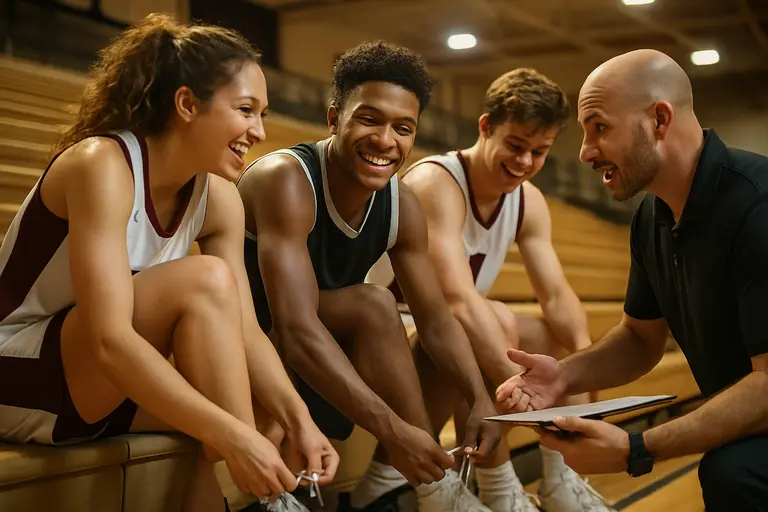
Huntington Beach’s rise also points to the value of structure. Coach Matthew Hatchette’s approach, as described in the Los Angeles Times report, emphasized execution of college- and NFL-style systems, detailed reads, chemistry, and daily discipline. That matters because high school athletes often hear about talent before they hear about learning speed.
A talented player can win a rep. A trained player can repeat the right decision across a full game. The gap between those two ideas is where many seasons are decided. If an athlete does not understand the system, physical ability becomes harder to use. If a receiver cannot read coverage the same way as the quarterback, timing suffers. If a linebacker does not fit the run as coached, one missed step can open the field.
That is why Huntington Beach success should be read as a process story, not just a highlight story. The public sees the touchdown pass. Coaches see the footwork, the check, the route depth, the protection call, and the practice reps that made the throw possible. Athletes who want similar growth should ask better questions in film, learn why a drill is being repeated, and take correction without treating it as criticism.
Why Academics Stay In The Frame
The school setting matters, too. Huntington Beach Union High School District describes academic programs that include AVID and International Baccalaureate, while also pointing to interscholastic championships as part of its student experience on its district information page. That pairing is worth attention because high school sports do not exist in a vacuum.
Eligibility, time management, class attendance, and personal conduct all affect athletic opportunity. A player who cannot manage the school day will have a hard time managing a game plan. A team that values only Friday night performance risks missing the habits that support Friday night performance. For families across California, this is one of the clearest lessons: athletic ambition and academic discipline should reinforce each other.
- Prepare early: Treat the first game, meet, or match as a real measure of readiness.
- Learn multiple roles: Versatility gives coaches more reasons to trust an athlete.
- Study the system: Talent grows faster when players understand assignments and reads.
- Respect school standards: Academic habits protect athletic opportunity.
- Use strong performances well: Let individual success raise the team’s daily standard.
What Local Athletes Can Learn From Huntington Beach Success
Build Habits That Travel
The most useful part of Huntington Beach success is that its lessons travel. A Bay Area lacrosse player, a Central Coast distance runner, and an Inland Empire lineman can all take something from the same model. The details of each sport change, but the habits remain familiar: prepare before the stage gets bigger, learn more than one job, accept coaching, and connect personal goals to team standards.
That last point is easy to say and hard to live. A record passing night depends on receivers, protection, play calls, spacing, and defensive stops. A two-way standout depends on conditioning, communication, and the willingness to take extra responsibility. Great high school performances may look individual in the headline, but they are usually team-built underneath.
A California Prep Model With Limits
There is also a caution here. Not every athlete will throw for 446 yards, catch three touchdowns, or commit to a Power Five program. That should not make the model less useful. Copying the outcome is not the goal. Copying the habits is the point.
Local athletes should study Huntington Beach for what can be controlled: preparation, role clarity, effort in early contests, classroom responsibility, and the willingness to be coached. Those are practical targets for freshmen trying to earn a roster spot and seniors trying to leave a program better than they found it. In that sense, Huntington Beach success is less about one night in August and more about the daily choices that made that night possible.