
The San Francisco 49ers have turned to a familiar defensive cornerstone as they prepare for the decisive stretch of the 2026 NFL season. On October 27, San Francisco agreed to acquire three-time Pro Bowl defensive tackle DeForest Buckner from the Indianapolis Colts in exchange for a 2027 fourth-round draft pick, bringing the veteran back to the franchise that selected him seventh overall in the 2016 NFL Draft.
Buckner’s return has also sparked discussion among San Francisco fans about how the veteran defensive tackle could influence the 49ers’ playoff ambitions and their position in the competitive NFC West. Beyond traditional game analysis, football enthusiasts often turn to a sports betting forum to exchange opinions about team performances, upcoming matchups, and the potential impact of major roster changes. While Buckner’s experience and interior pass-rushing ability could strengthen San Francisco’s defense, his actual contribution will depend on his health, integration into Raheem Morris’s system, and the team’s ability to recover from its defensive-line injuries.
The reported agreement, pending Buckner’s physical, comes at an important moment for a 49ers team that entered its Week 8 bye with a 6–1 record despite a growing collection of defensive-line injuries. San Francisco’s first defeat, a 29–20 loss to the Atlanta Falcons on October 25, exposed the difficulties of generating consistent pressure without a fully healthy defensive front.
According to the NFL’s DeForest Buckner trade report, Indianapolis agreed to the deal ahead of the November 10 trade deadline. The transaction gives general manager John Lynch an experienced interior defender without sacrificing a premium early-round selection.
For San Francisco, the significance extends beyond a popular reunion. Buckner’s return creates an opportunity to improve interior pass rushing, stabilize defensive rotations, and protect a strong start to the season. Whether those improvements translate into a more dependable defense will depend on his integration into coordinator Raheem Morris’s system and the health of the players around him.
Why the 49ers Brought DeForest Buckner Back to San Francisco
Buckner’s return closes an unusual chapter in the 49ers’ recent roster history.
San Francisco drafted the University of Oregon standout with the seventh overall selection in 2016. He developed into one of the franchise’s most dependable defensive players, earning a Pro Bowl selection in 2018 after recording 12 sacks.
His combination of size, length, interior power, and pass-rushing ability made him an important part of the defense that helped San Francisco reach Super Bowl LIV following the 2019 season.
However, the 49ers traded Buckner to Indianapolis in March 2020 as they navigated difficult salary-cap decisions. In return, San Francisco received a first-round draft selection that it ultimately used on defensive tackle Javon Kinlaw.
The original transaction created considerable expectations for Kinlaw, but injuries prevented him from providing the sustained production Buckner had delivered. Meanwhile, Buckner established himself as a central figure in Indianapolis.
Six years later, the economics of the relationship have changed.
Instead of surrendering a first-round selection, San Francisco has agreed to give up a fourth-round pick in 2027 for a proven veteran who remains productive at age 32. The NFL’s original 2020 Buckner trade coverage provides context for how significantly the acquisition cost has changed. NFL.com+1
The new agreement does not guarantee that Buckner will reproduce his peak seasons. It does, however, provide the 49ers with an experienced player whose abilities directly address a current roster need.
DeForest Buckner’s 2026 Statistics Show He Can Still Produce
Buckner is not returning to California solely because of his reputation.
Through seven games with Indianapolis in 2026, he recorded four sacks, 31 combined tackles, eight quarterback hits, four tackles for loss, three passes defended, and one fumble recovery.
Those numbers are particularly meaningful for an interior defensive lineman. Defensive tackles frequently face double teams, must maintain run-gap discipline, and generate pressure from positions where offensive linemen have less distance to recover.
Buckner’s ability to affect quarterbacks while maintaining a substantial defensive workload suggests he can contribute immediately if he passes his physical and adapts quickly to San Francisco’s assignments.
| Statistical Category | Buckner’s 2026 Production With Indianapolis |
|---|---|
| Games Played | 7 |
| Combined Tackles | 31 |
| Sacks | 4 |
| Quarterback Hits | 8 |
| Tackles for Loss | 4 |
| Passes Defended | 3 |
| Fumble Recoveries | 1 |
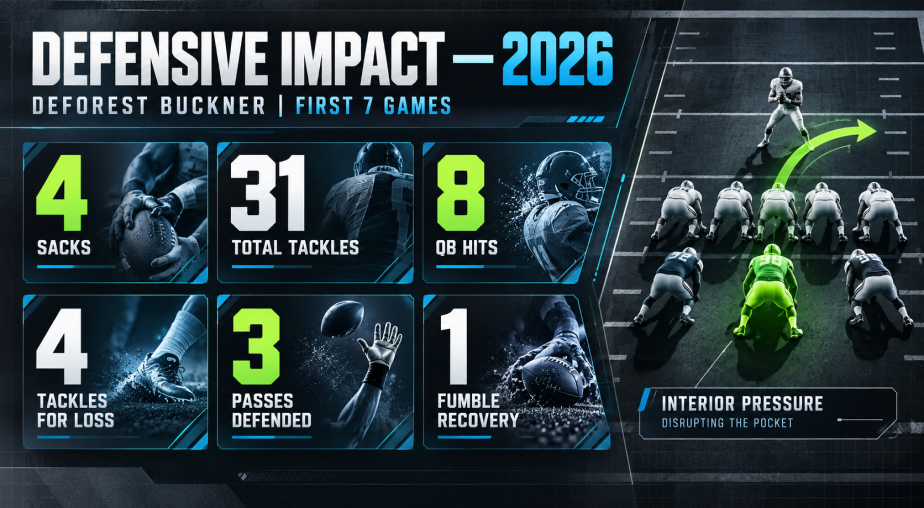
Buckner also brings a lengthy record of NFL production. Across 158 career games with San Francisco and Indianapolis entering the trade, he had accumulated 75.5 sacks and 101 tackles for loss.
His experience matters because San Francisco does not necessarily need another defensive lineman to dominate every snap. The more immediate requirement is a dependable interior presence who can improve the effectiveness of the entire front.
A productive defensive tackle can force quarterbacks away from comfortable passing lanes, reduce the space available for running backs, and create opportunities for edge rushers to finish plays.
That combination makes Buckner’s value potentially greater than his individual sack total.
What the Falcons Loss Revealed About San Francisco’s Defensive Line
The October 25 defeat against Atlanta provided an immediate example of why San Francisco needed additional defensive-line depth.
The Falcons won 29–20, with quarterback Michael Penix Jr. completing 25 of 34 passes for 213 yards and three touchdowns. San Francisco failed to record a sack.
Atlanta’s offensive approach reduced the opportunities for the 49ers to create favorable pass-rushing situations. Running back Bijan Robinson finished with 63 rushing yards on 20 carries and contributed another 59 yards as a receiver.
Although the 49ers prevented Robinson from producing a major rushing total, they struggled to consistently disrupt Atlanta’s passing offense.
The distinction is important. A defense can perform adequately against traditional rushing plays and still struggle when opposing quarterbacks operate from clean pockets.
San Francisco’s inability to sack Penix illustrated the limitations of its depleted front, particularly when opponents avoided obvious passing downs.
General manager John Lynch publicly expressed confidence in the team’s defensive personnel before the Buckner agreement emerged. Nevertheless, the subsequent trade demonstrated a willingness to reinforce the position.
The NFL’s analysis of the Buckner acquisition identifies the Atlanta game as an important test for Raheem Morris’s injury-affected defensive front.
The result should not be interpreted as evidence that San Francisco’s entire defense has collapsed. The 49ers entered their bye with six victories, and their broader defensive performance remained competitive.
Instead, Atlanta exposed a specific weakness that stronger opponents could target later in the season: the difficulty of generating reliable pressure when San Francisco cannot count on its preferred combination of defensive linemen.
Buckner offers a possible answer because he can create disruption from inside the formation rather than depending exclusively on edge pressure.
How Buckner Could Transform Raheem Morris’s Defensive Front
Defensive coordinator Raheem Morris now has an opportunity to rebuild the balance of San Francisco’s defensive line around a player capable of affecting both rushing and passing situations.
Buckner’s most obvious contribution should come from the interior, where his length and strength allow him to challenge guards and centers directly.
At 6 feet 7 inches and approximately 295 pounds, according to his official Indianapolis Colts player profile, Buckner presents a difficult blocking assignment for offensive linemen who must also account for pressure arriving from the outside. colts.com
His addition could help San Francisco in three interconnected ways.
First, Buckner provides an experienced interior pass rusher who can attack the pocket without requiring a blitz. Generating pressure with four defenders allows Morris to preserve more players in coverage and reduces the risk of exposing defensive backs against explosive passing offenses.
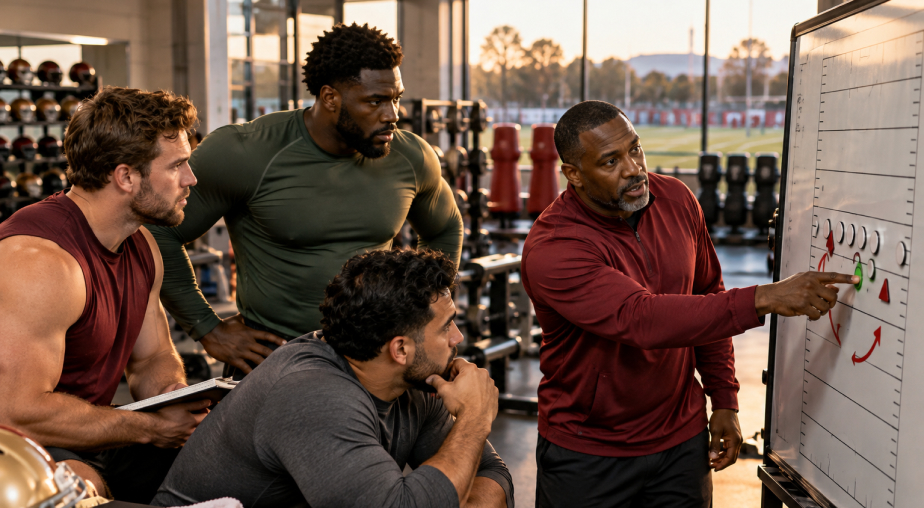
Second, Buckner can improve the effectiveness of the team’s edge rushers. When interior defenders force quarterbacks to move laterally, outside rushers have a better opportunity to close the distance and finish plays.
Third, his experience should help stabilize defensive rotations. Rather than asking younger players to handle demanding snap totals every week, San Francisco can distribute responsibilities across a deeper group.
The challenge will be integrating Buckner without disrupting the assignments that have already worked.
Morris must determine which combinations produce the strongest run defense, which players are most effective on passing downs, and how Buckner’s arrival changes the responsibilities of other interior defenders.
Those decisions will become increasingly important as San Francisco prepares for opponents capable of adjusting their protection schemes.
Nick Bosa’s Health Remains Central to the 49ers’ Pass Rush
Buckner’s acquisition addresses an important weakness, but it does not eliminate San Francisco’s injury concerns.
Defensive end Nick Bosa has missed time with a calf injury, limiting the team’s ability to generate pressure from its most established edge-rushing position.
According to reporting surrounding the trade, Lynch expressed optimism that Bosa could return following the Week 8 bye. However, his availability and workload remain subject to medical evaluation.
San Francisco has also dealt with injuries elsewhere along the defensive front.
Alfred Collins suffered a season-ending knee injury, while C.J. West has been unavailable. Mykel Williams has been working his way back following knee surgery, creating additional challenges for a unit that has needed contributions from several younger defenders.
The arrival of Buckner offers a different type of solution from simply waiting for injured players to return.
If Bosa becomes available, the 49ers could assemble a front featuring Bosa, Buckner, Osa Odighizuwa, and Williams, with players such as Keion White, Gracen Halton, and Romello Height contributing to the rotation.
That combination would provide multiple avenues for creating pressure rather than depending on one individual defender.
The NFL’s assessment of San Francisco’s defensive-line injuries emphasizes how the team’s personnel losses have complicated its pass-rushing plans. NFL.com
Nevertheless, the projected lineup remains a possibility rather than an established combination. The effectiveness of that group depends on player availability, conditioning, and how quickly the defensive staff can develop reliable communication.
Buckner can improve the situation, but he cannot independently resolve every injury-related limitation.
Why the 2027 Fourth-Round Pick Makes Financial Sense
The acquisition also represents an interesting roster-management decision for general manager John Lynch.
San Francisco is surrendering a future fourth-round selection rather than a first- or second-round pick, preserving more valuable draft resources while adding an established player for the current season.
That is an important distinction for a team attempting to compete immediately without completely sacrificing its future.
Buckner signed a two-year, $46 million extension with Indianapolis in April 2024. He is in the final season of that agreement and is scheduled to become an unrestricted free agent during the 2027 offseason unless San Francisco reaches a new arrangement with him.
Consequently, the trade carries both immediate value and long-term uncertainty.
The 49ers are acquiring an experienced defender who can contribute during the remainder of 2026, but they are not automatically securing him for multiple future seasons.
That structure helps explain the relatively modest draft compensation.
For Indianapolis, the transaction provides an additional selection as the organization begins reshaping its roster following a difficult start.
For San Francisco, the deal represents an opportunity to improve a potential playoff team without committing a major package of future picks.
The NBC Sports Bay Area report on Buckner’s return outlines the veteran’s contract situation and the fourth-round compensation involved. NBC Bay Area
The longer-term financial question will depend on Buckner’s performance.
If he becomes an essential part of the defensive line, San Francisco could consider negotiating another contract. If the partnership proves temporary, the 49ers will have used a middle-round selection to strengthen their defense during a season with legitimate championship ambitions.
Either outcome is more manageable than a trade involving multiple premium draft picks.
The Colts’ Rebuilding Strategy Creates an Opportunity for San Francisco
The Buckner transaction was part of a broader series of moves by Indianapolis on October 27.
The Colts also agreed to send All-Pro offensive guard Quenton Nelson to the Seattle Seahawks in exchange for draft compensation.
Indianapolis entered the week with a 2–5 record, having struggled to establish consistency throughout the season. The organization had also dismissed general manager Chris Ballard, signaling a significant change in its football operations.
Moving established veterans provides Indianapolis with additional draft resources and greater flexibility as it evaluates the direction of the franchise.
For San Francisco, those circumstances created an opportunity to acquire a player who might not otherwise have become available.
Buckner’s age, contract status, and the Colts’ disappointing record combined to make a trade more realistic.
The timing is particularly significant because Seattle, another NFC West contender, was also active in the trade market.
The Seahawks’ acquisition of Nelson gives their offensive line a proven veteran, while San Francisco’s agreement for Buckner reinforces the defensive interior.
Those parallel moves demonstrate how divisional rivals can approach the same trade deadline with different priorities.
Seattle is strengthening its offensive protection and run-blocking capabilities. San Francisco is attempting to increase defensive disruption and withstand injuries.
The Associated Press report on the Buckner trade details Indianapolis’s roster changes and the circumstances surrounding both transactions. The Washington Post
For California football fans, the developing competition between San Francisco and Seattle adds another layer of significance to the Buckner reunion.
The trade is not simply about improving one position. It is also about maintaining a competitive advantage within a division where opponents are actively strengthening their rosters.
What Buckner’s Return Means for the NFC West Race
San Francisco entered its Week 8 bye at 6–1, giving the team a strong position as the regular season approaches November.
That record provides some flexibility, but it also creates expectations.
A team with six victories in its first seven games cannot afford to ignore weaknesses that could become more damaging against playoff-caliber opponents.
Buckner’s arrival should be evaluated against that competitive context.
The 49ers do not need him to transform a struggling defense into a respectable unit. They need him to help turn an already competitive group into one capable of handling more demanding matchups.
The distinction affects how success should be measured.
A successful Buckner acquisition might not produce a dramatic increase in his individual sack total. Instead, it could improve the team’s ability to defend third downs, force quarterbacks into uncomfortable throws, and prevent opponents from controlling games through sustained offensive drives.
Interior pressure can also help defensive backs by reducing the amount of time they must maintain coverage.
Those benefits are particularly valuable against quarterbacks who distribute the ball quickly and punish defenses that rely too heavily on blitzing.
Buckner’s experience in major games also carries relevance.
He was part of San Francisco’s Super Bowl LIV team and understands the expectations surrounding a franchise that regularly measures itself against championship standards.
That familiarity should help his transition into the organization, although he will still need to learn Morris’s current terminology and defensive responsibilities.
The ultimate measure of the trade will be how much more reliable San Francisco becomes against strong offensive opponents.
The Week 8 Bye Gives Buckner Time to Adjust
One advantage of the trade’s timing is that San Francisco does not have to rush Buckner directly into a game.
The 49ers are on their Week 8 bye, providing additional preparation time before their next scheduled matchup against the Las Vegas Raiders at Levi’s Stadium in Santa Clara.
That period should allow Buckner to complete the necessary medical and administrative steps, become familiar with the defensive playbook, and begin working with his new teammates.
It also gives Morris time to evaluate how Buckner fits alongside the existing defensive personnel.
The coaching staff can use the break to review Atlanta’s successful offensive approach and identify adjustments that do not depend entirely on the availability of injured players.
That work matters because adding a talented defender does not automatically correct communication problems, missed assignments, or ineffective pressure schemes.
San Francisco must ensure that Buckner’s individual strengths support the broader structure of its defense.
His return also creates an opportunity to reassess the defensive-line rotation before the final portion of the season.
The 49ers may be able to reduce the burden on younger players, introduce more flexible passing-down packages, and adjust interior assignments based on opponents.
Those improvements could help the team maintain defensive consistency over a demanding schedule.
Can DeForest Buckner Make the 49ers a Stronger Super Bowl Contender?
Buckner’s return is a significant move because it directly addresses a weakness that became visible during San Francisco’s first defeat.
His four sacks and eight quarterback hits through seven games demonstrate that he remains capable of contributing as an interior pass rusher. His experience, physical profile, and familiarity with the organization make him a logical addition to a defensive line affected by injuries.
However, the trade should not be treated as a complete solution.
San Francisco still needs healthier contributions from its edge rushers, improved pressure consistency, and effective defensive adjustments against opponents capable of neutralizing its front four.
Buckner can strengthen those efforts, but the outcome will depend on how the entire unit performs.
The November 10 trade deadline also leaves the 49ers with time to evaluate additional opportunities. Whether Lynch pursues further reinforcements will likely depend on injury developments, roster needs, and the availability of suitable players.
For now, the organization has made a calculated decision to reinforce a 6–1 team rather than wait for its defensive problems to become more serious.
The most encouraging aspect of the transaction is that San Francisco has acquired a proven contributor at a position of immediate need without sacrificing a premium draft pick.
The remaining question is whether Buckner’s presence can help restore the consistent interior pressure that defined some of the franchise’s strongest recent defenses.
If he can help the 49ers generate pressure without relying on frequent blitzes, maintain better control of the line of scrimmage, and support the eventual return of injured teammates, the reunion could become one of the most consequential defensive moves of the 2026 NFL trade deadline.